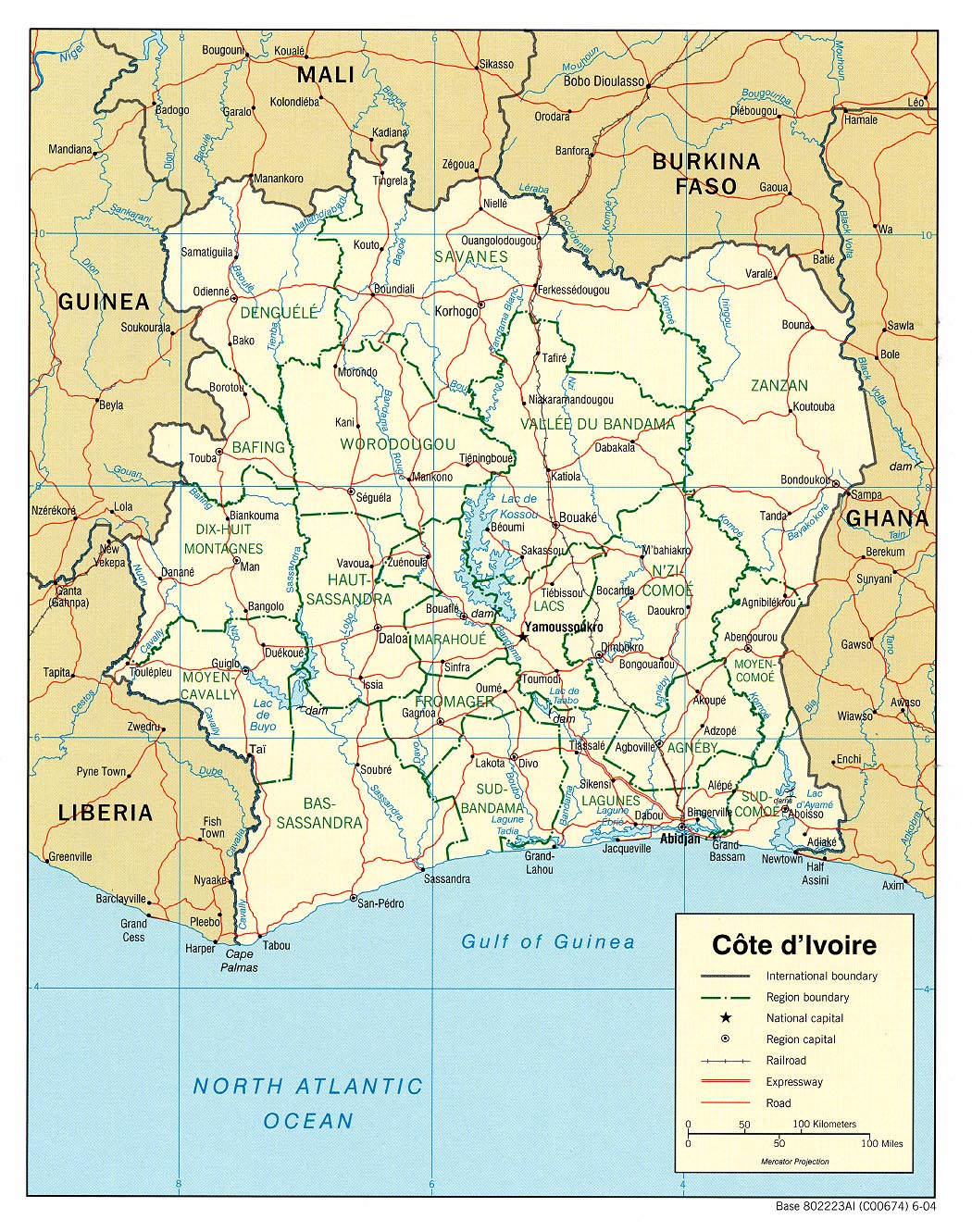
Cocoa rose to a 32-year high in New York on concern that supplies from Ivory Coast, the world’s biggest producer, will continue to be disrupted as an export ban of the chocolate ingredient is extended.
Alassan Ouattara, the internationally recognized winner of the November presidential elections, will extend a ban that was imposed Jan. 23 and scheduled to expire this week, according to Malick Tohe, a cocoa adviser to Quattara. Before today, the commodity has gained 25 percent since late November.
“With no end to the political problems in sight, prices will remain buoyant,” said Jack Scoville, a vice president at Price Futures Group Inc. in Chicago. “Exports from the country are impossible, so people are worried about deterioration of the beans.”
Cocoa for May delivery climbed $87, or 2.5 percent, to settle at $3,586 a metric ton at 12 p.m. on ICE Futures U.S. in New York, after touching $3,608, the highest price since January 1979. Trading was closed yesterday for the U.S. Presidents Day holiday.
Scoville said he expects the price to rise to $3,655 by the end of this week.
In London, cocoa for March delivery rose 61 pounds, or 2.7 percent, to 2,362 pounds ($3,808) a ton on NYSE Liffe.
In Ivory Coast’s main port of Abidjan, the army has “reinforced the deployment” of troops to help keep order, Hilaire Babri Gohourou, an army spokesman, said on state-owned Radio Television Ivoirienne yesterday. At least 300 people have been killed in clashes since the vote, according to the United Nations.
Shipments of cocoa beans and processed cocoa products registered at Ivory Coast’s ports for export totaled 662,409 tons from start of the season on Oct. 1 through Feb. 17, according to an industry official with access to the data. In the 14 days to Feb. 17, cocoa-bean exports totaled 8,645 tons, said the official, who declined to be identified because the data are confidential.
source: http://www.bloomberg.com/news/2011-02-22/cocoa-advances-to-highest-price-since-1979-on-ivory-coast-supply-concerns.html
Tuesday, February 22, 2011
UPDATE: SOFTS-ICE coffee, cocoa at highest in more than 30 years
* Brazil in no rush to sell coffee as prices surge
* Ivory Coast cocoa exports dry up as crisis deepens
* Sugar boosted by prospect of European Union imports
(Adds quotes, bylines, background)
By Sarah McFarlane and Nigel Hunt
LONDON, Feb 22 (Reuters) - Cocoa and arabica coffee futures
rose to the highest levels in more than three decades on ICE on
Tuesday, with cocoa driven by turmoil in top grower Ivory Coast
and coffee by tight supplies of high quality beans.
Cocoa futures have been rising as the crisis in Ivory Coast
has shut down international banks and has led to a virtual halt
in exports.
Ivorian troops killed at least six protesters who were
calling on Laurent Gbagbo to step down as leader on Monday,
witnesses said, as African presidents charged with resolving the
crisis met the incumbent in Abidjan. [ID:nLDE71K1E6]
"The situation is not getting any better," said Kona Haque,
commodity strategist at Macquarie Bank. "I think the risks are
rising for short-term supply disruptions."
May cocoa futures on ICE CCc2 stood $38 or 1.1 percent
higher at $3,537 a tonne after rising earlier to a 32-year peak
for the second month of $3,574.
Prices on Liffe also advanced with May LCCc2 up 28 pounds
or 1.2 percent at 2,314 pounds a tonne.
In a bid to starve Gbagbo's government of funding from the
cocoa trade, rival Alassane Ouattara has called on exporters to
suspend business during the month of February and has left open
the option of a longer embargo, which dealers fear could cause
major problems for global cocoa supplies.
"There's a big risk of the ban being extended into the
mid-crop," Haque said.
COFFEE, SUGAR
Coffee prices have doubled since June 2010 with supplies
tightened by three consecutive below-par harvests in Colombia,
the world's top producer of high quality washed arabica beans.
"Physical (coffee) prices are still very strong, and Brazil
are in no rush to sell," Haque said. "A good chunk of the
farmers are pretty much sold out anyway."
May arabica futures KCc2 stood 2.00 cents or 0.7 percent
higher at $2.75 per lb at 1200 GMT. The contract earlier peaked
at $2.78 per lb, the highest level for the second month in more
than 30 years.
Coffee prices soared to record levels in 1977 after severe
frost cut the 1976/77 Brazilian crop to around 9.3 million bags
from an expected 22 million.
Dealers said that buying by roasters was limiting any
downward moves.
"Roasters seem to be not as well covered as was thought,
given you see buying every time the market dips," Haque said.
Robusta coffee futures on Liffe also rose with May LRCc2
peaking at $2,417 a tonne, the highest level for the second
month since March 2008. Prices subsequently slipped back to
$2,392 a tonne, still up $5 or 0.2 percent.
Sugar prices were also higher, boosted by the prospect of
increased imports into the European Union.
A European Union committee will vote on Thursday on whether
to open a new import quota for sugar at reduced duties, to ease
a supply shortage on the EU market, the European Commission said
on Monday. [ID:nLDE71K1II]
"The strength of the markets this morning may be as a result
of a vote by an EU committee on Thursday on whether to open a
new import quota for sugar at reduced duties to ease a current
supply shortage," Sucden Financial said in a market note.
"If approved, there would be increased imports of both
whites and raw sugar from the world market," Sucden added.
March raw sugar futures on ICE SBc1 rose 0.32 cent or 1.0
percent to 31.34 cents a lb while May whites on Liffe LSUc1
climbed $3.80 to $728.30 per tonne.
source: http://af.reuters.com/article/commoditiesNews/idAFLDE71L1AB20110222

VIETNAM: Coffee-Prices rise, farmers keep beans
Vietnamese robusta coffee have risen around 6 percent in the past week to a new record high following gains in global market, prompting farmers to further hold back sales, traders said on Tuesday.
Robusta beans rose to new all-time highs of between 44.5 million dong and 45 million dong ($2,132-$2,156) per tonne on the domestic market, from 42.2 million dong a week ago, which was itself a record.
Liffe May robusta coffee closed up $32 at $2,337 a tonne on Monday after peaking at a 2-1/2 year high for the second month of $2,358. The market was supported by a surge in arabica prices.
An increase of 20.6 percent since the end of 2010 has brought local prices in Vietnam, the world's largest producer of robusta beans, closer to the level of 50 million dong per tonne at which farmers are expected to unload more beans, traders said.
"They still hold 30 percent of the crop and are not selling," an exporter in the key growing province of Daklak said, based on his output estimate of 1 million tonnes, or 16.67 million bags.
Vietnam has shipped 300,000 tonnes and another 400,000 tonnes were kept in warehouses of foreign buyers and exporters, he said.
His estimate is well below an International Coffee Organization's data of 18.43 million 60-kg bags.
DONG DEVALUATION
The all-time high is in local currency terms. The dong was devalued by 8.5 percent against the dollar on Feb. 11.
Vietnamese robusta beans grade 2, 5 percent black and broken rose to $2,240-$2,250 a tonne, free-on-board, from $2,135-$2,145 last Tuesday, as discounts to London's May contract stood unchanged at $140-$150 a tonne.
Higher prices have prompted farmers to slow sales, a trader in Ho Chi Minh City said.
Prices have nearly doubled from 22.5 million dong per tonne in Daklak on Feb. 23, 2010. The province accounts for about a third of Vietnam's total coffee.
WATERING UNDER WAY
Farmers in the Central Highlands coffee belt are due to start a second phase of tree watering soon for the 2011/2012 crop.
The watering process and fertiliser feeding often last from February to early May before the rainy season returns to the area, which produces about 80 percent of Vietnam's coffee.
The region is forecast to face a severe drought this year, which could affect coffee output, the ruling Communist Part-run Nhan Dan (People) daily quoted the Agriculture Ministry as saying. It gave no forecast damages.
The watering process, in three or four phases of around 20 days at a time, is essential to coffee flowering as it helps trees cope with the peak of the dry season in March.
Vietnam's coffee crop year lasts from October to September, starting with a four-month harvest.
Initial reports said some cherries did not contain solid beans inside, suggesting the next crop may not be good, Chairman Luong Van Tu of the Vietnam Coffee and Cocoa Association said last week in his first comments on the next crop.
Growers were scrambling for diesel to run water pumps as many fill-in stations in the Central Highlands have suspended sales or stopped selling diesel and only offered petrol in preparations for a retail price hike, state-run media reported.
"Now the fuel shortage is not really the farmers concern because coffee prices are high. Their attention is the extent of the price rally," the Daklak-based exporter said.
($1=20,875 dong)
Gambling on food prices could be an unhealthy wager
Speculation and scarcity, droughts and floods add up to a crisis.
STOP playing with your food! That's a childhood lesson banks and investors should remember. They have helped create the global food crisis, putting upward pressure on inflation, threatening world peace and toppling governments.
Index funds and commodity providers have provided access to the fast-moving price of food. In the past year, the prices of wheat, corn and coffee have risen beyond 2008 levels. This helped create the volatile component that produced outrage in the streets of Egypt, Libya and elsewhere in the Middle East.
A Credit Suisse analysis found that Egypt spends more on food than other emerging economies - about 40 per cent of individual monthly income, compared with about 17 per cent for Brazilians and about 20 per cent for Chinese and Saudi Arabians. The food crisis also ousted the government in Tunisia and forced the Jordanian king to replace his government.
In recent weeks, some have blamed the food crisis on US Federal Reserve chairman Ben Bernanke and his quantitative easing policies. Ever since QE2 was announced in November, commodity prices have surged. Critics say it flooded the world with liquidity, which in turn devalued the dollar and drove institutional investors out of US treasuries and encouraged them to seek higher returns for food commodities.
Speculation has also contributed to the food crisis, an explanation for a situation where a billion people around the world face starvation when one in 10 of the population is obese.
For many years food was regarded as a bad speculative investment because it was perishable. Enter Goldman Sachs in the early 1990s. Recognising that it could make millions from our daily bread, it established the Goldman Sachs Commodities Index that took commodities like coffee, cattle, cocoa and corn and calculated their investment value.
Other investment banks followed and, as a result, there was a significant shift in investment in the first 10 years of this century. Following the equity bear market of 2000-02, commodity futures were identified as a new asset class for institutional investment.
Commodities behave differently from equities and bonds, creating more diversification for a given level of risk. Driving it further were changes in the 1990s, after lobbying by banks, hedge funds and free-market champions in the US and Britain, when regulations on commodity markets were abolished and contracts to buy and sell foods were turned into ''derivatives'' that could be traded by people who knew nothing about agriculture.
Analysts say that assets related to commodity trading index strategies rose from $US13 billion at the end of 2003, to $US260 billion in March 2008.
This is the way it worked. Instead of placing buy and sell orders, the banks tended to "go long" and bought, for example, wheat futures, rolling over contracts. With supply and demand forces, prices go up when supply is low, but in this case, they rose because Goldman Sachs and the banks created artificial demand. From 2006, food prices began rising, culminating in food riots around the world in 2008.
With food and energy emerging as the defining issues of 2011, we can expect further political heat will be generated. Head of the Group of 20, French President Nicolas Sarkozy, has already called for rules to curb commodity volatility.
Still, it's not just the speculators that have driven up food prices. The food crisis is also the product of the recent floods, cyclones and droughts, and scarcities of good land, energy, nutrients, technology and fish, as well as population growth, rising consumer demand and protectionist trade policies.
A confluence of forces has created this crisis and, as a result, there is no silver bullet. It will require global action similar to the kind now being attempted to combat climate change to rectify.
There is another danger. Speculators may well be creating the kind of price spikes and volatility last seen in the US housing bubble. Like other Wall Street quirks, it could end disastrously.
In the meantime, people will continue dying of hunger and governments will tremble. Sarkozy might have a point: the world needs to tackle the root causes of the crisis in Egypt before it takes hold of other nations or causes another crisis.
source: http://www.smh.com.au/business/gambling-on-food-prices-could-be-an-unhealthy-wager-20110221-1b2k9.html
STOP playing with your food! That's a childhood lesson banks and investors should remember. They have helped create the global food crisis, putting upward pressure on inflation, threatening world peace and toppling governments.
Index funds and commodity providers have provided access to the fast-moving price of food. In the past year, the prices of wheat, corn and coffee have risen beyond 2008 levels. This helped create the volatile component that produced outrage in the streets of Egypt, Libya and elsewhere in the Middle East.
A Credit Suisse analysis found that Egypt spends more on food than other emerging economies - about 40 per cent of individual monthly income, compared with about 17 per cent for Brazilians and about 20 per cent for Chinese and Saudi Arabians. The food crisis also ousted the government in Tunisia and forced the Jordanian king to replace his government.
Advertisement: Story continues below
Certainly wild weather around the world has disrupted agricultural production but there are other forces equally as disturbing. They might point to another financial meltdown.In recent weeks, some have blamed the food crisis on US Federal Reserve chairman Ben Bernanke and his quantitative easing policies. Ever since QE2 was announced in November, commodity prices have surged. Critics say it flooded the world with liquidity, which in turn devalued the dollar and drove institutional investors out of US treasuries and encouraged them to seek higher returns for food commodities.
Speculation has also contributed to the food crisis, an explanation for a situation where a billion people around the world face starvation when one in 10 of the population is obese.
For many years food was regarded as a bad speculative investment because it was perishable. Enter Goldman Sachs in the early 1990s. Recognising that it could make millions from our daily bread, it established the Goldman Sachs Commodities Index that took commodities like coffee, cattle, cocoa and corn and calculated their investment value.
Other investment banks followed and, as a result, there was a significant shift in investment in the first 10 years of this century. Following the equity bear market of 2000-02, commodity futures were identified as a new asset class for institutional investment.
Commodities behave differently from equities and bonds, creating more diversification for a given level of risk. Driving it further were changes in the 1990s, after lobbying by banks, hedge funds and free-market champions in the US and Britain, when regulations on commodity markets were abolished and contracts to buy and sell foods were turned into ''derivatives'' that could be traded by people who knew nothing about agriculture.
Analysts say that assets related to commodity trading index strategies rose from $US13 billion at the end of 2003, to $US260 billion in March 2008.
This is the way it worked. Instead of placing buy and sell orders, the banks tended to "go long" and bought, for example, wheat futures, rolling over contracts. With supply and demand forces, prices go up when supply is low, but in this case, they rose because Goldman Sachs and the banks created artificial demand. From 2006, food prices began rising, culminating in food riots around the world in 2008.
With food and energy emerging as the defining issues of 2011, we can expect further political heat will be generated. Head of the Group of 20, French President Nicolas Sarkozy, has already called for rules to curb commodity volatility.
Still, it's not just the speculators that have driven up food prices. The food crisis is also the product of the recent floods, cyclones and droughts, and scarcities of good land, energy, nutrients, technology and fish, as well as population growth, rising consumer demand and protectionist trade policies.
A confluence of forces has created this crisis and, as a result, there is no silver bullet. It will require global action similar to the kind now being attempted to combat climate change to rectify.
There is another danger. Speculators may well be creating the kind of price spikes and volatility last seen in the US housing bubble. Like other Wall Street quirks, it could end disastrously.
In the meantime, people will continue dying of hunger and governments will tremble. Sarkozy might have a point: the world needs to tackle the root causes of the crisis in Egypt before it takes hold of other nations or causes another crisis.
source: http://www.smh.com.au/business/gambling-on-food-prices-could-be-an-unhealthy-wager-20110221-1b2k9.html
Coffee to touch new highs on supply concerns
Coffee prices in the international market are expected to touch new highs in the near term on the back of tight supply coupled with speculation buying before a possible correction in the next six to nine months.
 While arabica prices in ICE Futures are now at 14-year high of $2.72 a pound for March delivery, robusta is at $2,290 a tonne for March delivery in Liffe futures.
“Due to supply concerns in Brazil and Columbia, two major producers of arabica, prices are expected to reach $2.90 a pound in the near term,” Ramesh Rajah, president of Coffee Exporters’ Association said. Though speculation buying along with holding back of stocks are fueling such price rise, arabica prices will see correction in the next six to nine months, he added.
Meantime, robusta variety of coffee may also firm up in the future due to higher consumption demand and speculation buying.
“Though robusta will not see much upside, it may reach $2,400 a tonne in the next three months before a correction,” Rajah said.
Along with supply constraints, falling inventory level will support this trend. According to the International Coffee Organisation, stocks registered with New York’s coffee exchange have fallen sharply in the last one year.
As physical beans from Colombia and Central America are being traded at a premium to New York exchange, traders are unlikely to give their produce to warehouse of the exchange.
“In the wake of the overall demand-supply scenario along with increase in consumption, prices of both variety of coffee have an upward bias in the near future,” Jawaid Akhtar, chairman of Coffee Board of India said. He, however, declined to give any specific figure saying that it would depend not only on demand-supply scenario, but also on the overall market sentiment. Meantime, price difference between arabica and robusta variety has touched an all-time high level after 1997 in the recent time, which may prompt planters to shift to arabica variety.
“Though a bigger price difference should trigger shifting to arabica variety, higher gestation period of four to five years of arabica will discourage planters to opt for this variety,” Marvin Rodrigues, vice-president of Karnataka Planters’ Association said.
He also said that growing arabica was difficult as compared to robusta due to higher labour requirement and other factors.
Despite high international prices, coffee retailers are not ready to pass on the price rise to end consumers yet.
“We know that prices are at all-time high. However, retail prices are not expected to follow suit as we procure most of our produce from captive estates,” K Ramakrishnan, marketing head of Cafe Coffee Day said. He also said retail prices had to follow a stable cycle for sound business growth.
source:
http://www.business-standard.com/india/news/coffee-to-touch-new-highssupply-concerns/425974/
While arabica prices in ICE Futures are now at 14-year high of $2.72 a pound for March delivery, robusta is at $2,290 a tonne for March delivery in Liffe futures.| | |||||||||||||||||||||||||||||||||||
| |||||||||||||||||||||||||||||||||||


Meantime, robusta variety of coffee may also firm up in the future due to higher consumption demand and speculation buying.
“Though robusta will not see much upside, it may reach $2,400 a tonne in the next three months before a correction,” Rajah said.
Along with supply constraints, falling inventory level will support this trend. According to the International Coffee Organisation, stocks registered with New York’s coffee exchange have fallen sharply in the last one year.
As physical beans from Colombia and Central America are being traded at a premium to New York exchange, traders are unlikely to give their produce to warehouse of the exchange.
“In the wake of the overall demand-supply scenario along with increase in consumption, prices of both variety of coffee have an upward bias in the near future,” Jawaid Akhtar, chairman of Coffee Board of India said. He, however, declined to give any specific figure saying that it would depend not only on demand-supply scenario, but also on the overall market sentiment. Meantime, price difference between arabica and robusta variety has touched an all-time high level after 1997 in the recent time, which may prompt planters to shift to arabica variety.
“Though a bigger price difference should trigger shifting to arabica variety, higher gestation period of four to five years of arabica will discourage planters to opt for this variety,” Marvin Rodrigues, vice-president of Karnataka Planters’ Association said.
He also said that growing arabica was difficult as compared to robusta due to higher labour requirement and other factors.
Despite high international prices, coffee retailers are not ready to pass on the price rise to end consumers yet.
“We know that prices are at all-time high. However, retail prices are not expected to follow suit as we procure most of our produce from captive estates,” K Ramakrishnan, marketing head of Cafe Coffee Day said. He also said retail prices had to follow a stable cycle for sound business growth.
source:
http://www.business-standard.com/india/news/coffee-to-touch-new-highssupply-concerns/425974/
Vietnam coffee prices rise to all-time high
HANOI, Feb 22 (Reuters) - Vietnamese robusta coffee rose on Tuesday to between 44.5 million dong and 45 million dong ($2,132-$2,156) per tonne on the domestic market, hitting a record high following gains in global markets.
Prices in Vietnam, the world's largest producer of robusta beans, were up from 42.2 million dong a week ago, which was itself a record as London futures traded at a 2-1/2-year high, supported by a surge in arabica prices.
An increase of 20.6 percent since the end of 2010 has brought local prices closer to the level of 50 million dong per tonne at which farmers are expected to unload more beans, traders said.
The all-time high is in local currency terms. The dong <VND=VN> was devalued by 8.5 percent against the dollar on Feb. 11.
Farmers in the Central Highlands coffee belt are due to start a second phase of tree watering soon for the 2011/2012 crop.
The watering process and fertiliser feeding often last from February to early May before the rainy season returns to the area, which produces about 80 percent of Vietnam's coffee.
The watering process, in three or four phases of around 20 days at a time, is essential to coffee flowering as it helps trees cope with the peak of the dry season in March.
Vietnam's coffee crop year lasts from October to September, starting with a four-month harvest.
Initial reports said some cherries did not contain solid beans inside, suggesting the next crop may not be good, Chairman Luong Van Tu of the Vietnam Coffee and Cocoa Association said last week in his first comments on the next crop. [ID:nHAN312381] ($1=20,875 dong)
Source: (Reporting by Ho Binh Minh; Editing by Alan Raybould) ((ho.minh@thomsonreuters.com; +844 3825 9623; Reuters Messaging: ho.minh.reuters.com@reuters.net)) ((If you have a query or comment on this story, send an email to news.feedback.asia@thomsonreuters.com)) Keywords: MARKETS VIETNAM/COFFEE
Market Close Review : Robusta coffee hits 2-1/2 year high, supplies tight
* Consumption growth triggers robusta coffee deficit
* Cocoa supported by turmoil in top grower Ivory Coast
* Sugar market awaits news on Indian exports
LONDON, Feb 21 (Reuters) - Robusta coffee futures climbed to a fresh 2-1/2 year high on Monday as the market retained its strong upward momentum, dealers said.
Cocoa futures on Liffe rose to 7-month highs as the market eyed the deepening crisis in top grower Ivory Coast.
White sugar edged up in a modest rebound after the steep setback in prices during the last couple of weeks.
ICE markets were shut on Monday for U.S. Presidents' Day.
"There's a lot of positive sentiment towards the coffee market," said Andrea Thompson, analyst at CoffeeNetwork, noting consumption growth was pushing the robusta market into deficit.
May robusta coffee <LRCc2> ended $50 or 2.1 percent higher at $2,387 a tonne. It earlier peaked at $2,389, the highest level for the second month since July 2008.
The advance in coffee has been led by ICE arabica futures <KCc2> which gained 7.1 percent last week and rose to their highest levels since May 1997, boosted by tight supplies following several below-par harvests in key producer Colombia.
High arabica prices have encouraged roasters to increase the volume of cheaper robusta beans in blends where possible.
"2010-11 should have been the third consecutive global surplus for robusta but it's now looking at a deficit. The
Vietnam crop is fairly stable, it's really more the consumption growth (driving the deficit)," Thompson said.
Vietnam is the world's top producer of robusta coffee.
Brazil, the world's biggest coffee producer, is holding back its big bean stocks and hoping for improved market conditions in a wager that world prices will keep on rising, its top coffee
official said on Friday.
PROTESTERS KILLED
Cocoa futures rose as tensions in Ivory Coast showed no sign of easing and port arrivals slowed to a trickle, heightening concern about supply from the world's top grower.
Ivorian troops killed at least four protesters calling on Laurent Gbagbo to step down as leader on Monday, witnesses said, as African presidents charged with resolving Ivory Coast's crisis arrived in Abidjan.
European Union sanctions and an export ban imposed by presidential claimant Alassane Ouattara have severely disrupted shipments of cocoa out of Ivory Coast.
"Restriction to the flow of cocoa from the ports is no doubt having an effect with numbers ranging from 200-300,000 tonnes going nowhere, although allegedly smuggling is taking place," a London-based broker said.
May cocoa on Liffe <LCCc2> ended 23 pounds higher at 2,286 pounds a tonne after earlier touching 2,297 pounds, the highest level for the second month since July 2010.
White sugar futures were slightly higher with the market still keenly awaiting a decision from India on whether to export 500,000 tonnes under Open General License (OGL).
In December, India's farm minister had said mills could export 500,000 tonnes of sugar under OGL. But the government, bowing to public pressure over food prices, has referred the issue to a panel of ministers.
May whites <LSUc1> rose $3.90 to end at $724.50 a tonne although prices remained far below a record peak for the front month of $857.00 set on Feb. 2.
The market has been weighed partly by expectations there may be a significant supply response to high prices. Consultancy Kingman on Sunday forecast a global sugar surplus of 5.6 million tonnes in 2011/12 (April/March).
Kingsman cautioned, however, that 2011/12 crop estimates should be viewed in light of very low global sugar stocks and climatic volatility.
"It will take months for the market situation to noticeably ease and a slump in prices is therefore not on the cards for the time being," Commerzbank said in a market report on Monday which noted the Kingsman forecast.
Source: ((nigel.hunt@reuters.com ; +44 207 542 8421; Reuters Messaging: nigel.hunt.thomsonreuters.com@reuters.net ))
Subscribe to:
Posts (Atom)